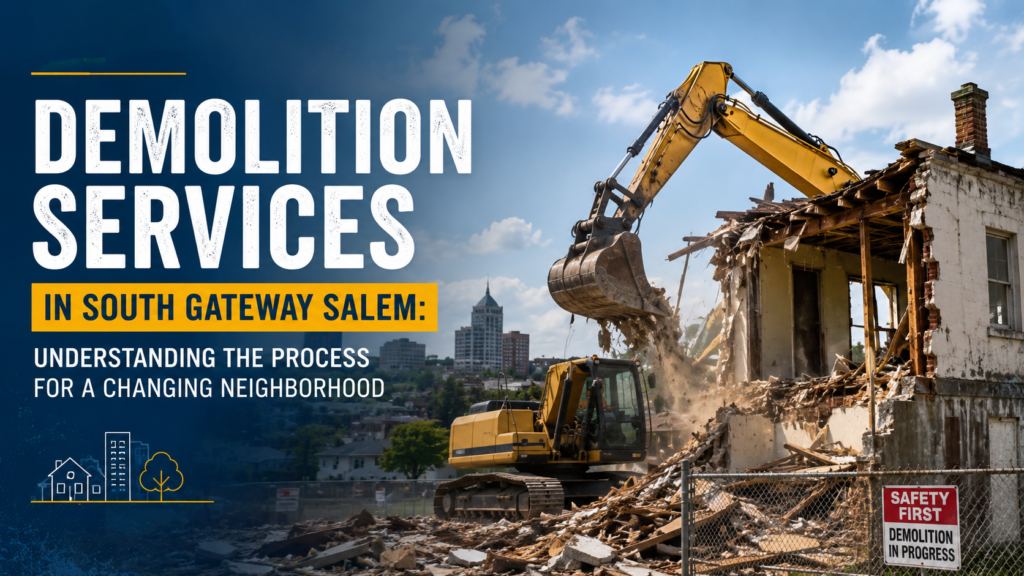
South Gateway is one of Salem’s most commercially active corridors, running along Commercial Street SE and the surrounding area at the southern end of the city. The neighborhood encompasses a mix of automotive businesses, industrial uses, retail, and residential parcels many of which are undergoing transitions as Salem’s urban landscape evolves. Demolition activity in South Gateway reflects this dynamic: older commercial buildings coming down to make way for updated facilities, deteriorated structures being cleared to improve neighborhood safety, and property owners preparing sites for new development.
Understanding what professional Demolition Contractor South Gateway services involve helps property owners, business operators, and developers navigate projects efficiently and compliantly.
The Commercial Character of South Gateway and Its Demolition Needs
The South Gateway area of Salem has historically served as a service and industrial corridor, with many structures built in the mid-to-late 20th century. As these buildings age and commercial needs shift, demolition becomes an increasingly common part of the neighborhood’s story. Typical demolition projects in this area include:
- Commercial building removal: Taking down older retail, office, or light industrial structures to prepare for redevelopment
- Site clearing for new commercial development: Clearing existing structures and site improvements to create a clean slate for new construction
- Partial or selective demolition: Removing specific portions of commercial structures as part of expansion or renovation projects
- Concrete and site infrastructure removal: Demolishing old parking lots, loading docks, and other concrete improvements
People Also Ask: Common Demolition Questions for South Gateway
What Is Selective Demolition and When Is It Used?
Not all demolition projects involve taking an entire structure to the ground. Selective demolition also called partial demolition or surgical demolition involves removing specific components of a structure while preserving the rest. This technique is commonly used when:
- A building is being reconfigured or expanded and specific sections need to be removed
- A tenant space is being renovated and interior walls, ceilings, and systems need to be cleared
- An addition is being removed from an otherwise sound structure
- Hazardous materials are being removed from specific locations within a building
Selective demolition requires precision and careful methodology to avoid damaging structural elements, utilities, and systems that need to remain intact. It typically relies more on manual labor and hand tools than on heavy mechanical equipment, and it requires careful sequencing to ensure structural stability throughout the process.
What Environmental Issues Are Encountered in Commercial Demolition?
Commercial structures particularly those built or last occupied in the mid-20th century often contain environmental hazards beyond asbestos. A thorough pre-demolition assessment for commercial properties in South Gateway may reveal:
- Lead-based paint: Common in commercial buildings constructed before 1978; requires abatement before demolition and specific disposal protocols
- Underground storage tanks (USTs): Automotive businesses and gas stations along the Commercial Street corridor may have buried fuel storage tanks that require removal and remediation
- Contaminated soil: Properties with industrial or automotive history may have petroleum-contaminated soil that requires remediation before or during site clearing
- PCBs in electrical equipment: Older transformers and fluorescent light ballasts may contain polychlorinated biphenyls, requiring specialized disposal
The Oregon Department of Environmental Quality (DEQ) oversees environmental compliance for demolition projects in Salem. Commercial demolition projects with known or suspected contamination require coordination with DEQ and may require environmental consultants and specialized remediation contractors before standard demolition can proceed.
How Does Commercial Demolition Differ from Residential Demolition?
Property owners and developers new to commercial demolition often wonder how it differs from residential projects they may be more familiar with. Key differences include:
- Scale and complexity: Commercial structures are typically larger, more complex in their systems, and involve more material to remove than residential properties
- Environmental compliance: The likelihood of encountering regulated materials is higher in commercial properties, and the regulatory framework is correspondingly more stringent
- Utility systems: Commercial buildings often have more complex utility infrastructure larger electrical services, roof-mounted mechanical systems, specialized plumbing that requires coordination with utility companies for disconnection
- Neighbor and community considerations: Commercial demolition in an active commercial corridor like South Gateway requires careful management of dust, noise, and traffic to minimize impacts on neighboring businesses
- Structural complexity: Some commercial buildings have concrete or steel construction that requires different demolition approaches than wood-frame residential structures
What Equipment Is Used in Commercial Demolition?
Professional demolition contractors bring specialized equipment to commercial projects:
- Hydraulic excavators: The primary tool for mechanical demolition of structures, equipped with various attachments (buckets, grapples, shears) for different phases of the work
- Skid steer loaders: Versatile machines for moving and sorting debris in confined areas
- Material processors: Attachments that crush and sort concrete from reinforcing steel on-site, facilitating recycling
- Roll-off containers: For collecting and transporting mixed debris to disposal and recycling facilities
- Vacuum excavation: For safely locating and exposing underground utilities and tanks
The selection of appropriate equipment for a specific project depends on the size and construction type of the structure, site access constraints, proximity to neighboring structures, and the extent of underground work required.
Site Preparation After Demolition in South Gateway
Once a structure is removed, the cleared site typically requires preparation for its next use. Site preparation work following demolition may include:
- Backfill and grading: Filling excavations left by foundations or underground tanks and grading the site to appropriate elevations and drainage patterns
- Foundation removal: Removing existing concrete foundations and footings to the depth required by new construction plans
- Soil testing and remediation: Verifying soil conditions and addressing any contamination identified during demolition
- Erosion control: Implementing temporary erosion control measures (silt fencing, straw waddles) to protect adjacent properties and storm drains during the period between demolition and new construction
Thorough site preparation during the demolition phase sets the foundation literally for successful new development in South Gateway.